
Blog
House Cleaners Cleaning Service: How to Choose the Right Residential Cleaning Plan
A house cleaners cleaning service is a professional residential cleaning arrangement in which a provider sends trained cleaners to complete an agreed scope of household work, either once or on a recurring schedule. For Charleston-area homeowners, renters, busy families, and property managers, the right choice depends on whether the immediate job is routine upkeep, neglected buildup, move preparation, or repeat service across several homes.
What a residential cleaning service actually includes
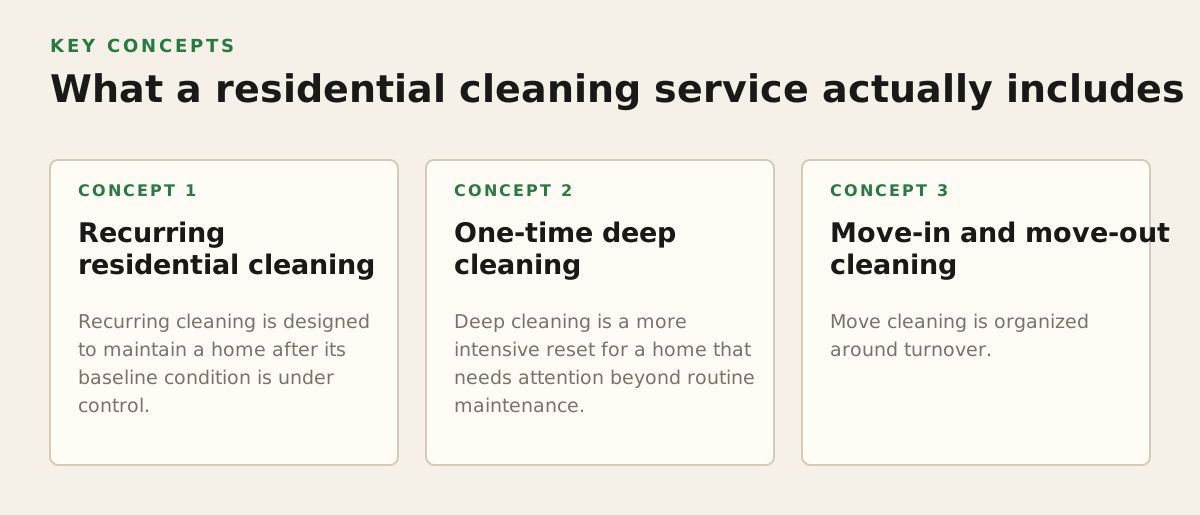
“House cleaning” is not one standardized product. It is a service category whose results depend on the scope, frequency, condition of the home, and access instructions. A reliable provider should describe what will be cleaned, what is excluded, how long the visit is expected to take, and what happens when the home needs more work than the selected service covers.
Recurring residential cleaning
Recurring cleaning is designed to maintain a home after its baseline condition is under control. Visits may be scheduled weekly, every other week, or at another agreed interval. The practical benefit is not that every visit becomes identical; it is that dust, hair, crumbs, bathroom residue, and kitchen messes are addressed before they become a larger reset.
This option fits a household that can handle occasional decluttering but does not want to spend its regular free time vacuuming, mopping, wiping surfaces, and cleaning bathrooms. It is less suitable when a property has substantial grease, scale, heavy dust, pet-related buildup, or areas that have not been cleaned for an extended period.
One-time deep cleaning
Deep cleaning is a more intensive reset for a home that needs attention beyond routine maintenance. Depending on the provider’s checklist, it may include detailed work on reachable trim, doors, baseboards, fixtures, edges, and buildup-prone kitchen or bathroom areas. The exact scope must be confirmed rather than assumed: “deep” is a marketing label unless the company supplies a written task list.
Consider deep cleaning in Charleston when moving into a property, preparing for guests, recovering from a busy season, or establishing a clean baseline before beginning recurring visits. Deep cleaning can require more preparation from the customer because clutter, dishes, laundry, and personal items may prevent access to the surfaces being serviced.
Move-in and move-out cleaning
Move cleaning is organized around turnover. A move-out appointment typically prioritizes empty rooms, kitchens, bathrooms, floors, reachable surfaces, and visible residue that may affect the next occupant or a property handoff. A move-in appointment focuses on making an otherwise vacant or nearly vacant home ready for occupancy.
These services are not automatically the same as repair, painting, junk removal, carpet restoration, mold remediation, pest treatment, or exterior washing. A buyer should ask whether appliances, inside cabinets, interior windows, walls, garages, and patios are included, and whether the property must be empty before cleaners arrive.
Why the category matters when comparing providers
The wrong service type creates two predictable problems: paying for work that does not address the real condition, or expecting a routine visit to produce a deep-clean result. A useful evaluation separates cleaning outcome from convenience. A company can arrive on time yet still be a poor fit if its checklist, products, access process, or quality-control method does not match the property.
Cleaning is different from disinfecting
Cleaning generally removes dirt and impurities from surfaces, while disinfecting uses a product intended to kill germs on surfaces. The U.S. Environmental Protection Agency explains the distinction and provides product information through its cleaning and disinfecting guidance: EPA cleaning and disinfecting. The Centers for Disease Control and Prevention also advises cleaning surfaces before disinfecting when disinfection is needed: CDC hygiene guidance.
That distinction matters for households asking for “sanitizing.” A normal residential visit may improve visible cleanliness without being a specialized infection-control service. Ask what the cleaner is being asked to do, which surfaces are included, and whether the provider follows label directions for any disinfectant. A provider should not imply that ordinary dusting or mopping guarantees a particular health outcome.
Products and surface compatibility
Cleaning products are part of the service specification, not a minor detail. Stone, finished wood, stainless steel, glass, painted surfaces, and delicate fixtures can react differently to chemicals or abrasive tools. Customers with children, pets, fragrance sensitivities, or respiratory concerns should disclose those conditions before booking and ask whether product alternatives are available.
The EPA’s Safer Choice program explains how products can be evaluated against ingredient and performance criteria. That does not mean every cleaning company uses certified products, nor does a label replace surface-specific judgment. It gives buyers a useful question: can the provider identify the products used and explain how they are selected?
Measurable success criteria
“Clean” becomes easier to evaluate when translated into observable conditions. A practical service brief might say that floors are free of visible debris, bathroom fixtures have no visible residue, kitchen counters are wiped, trash is removed from listed rooms, and requested rooms are accessible. These are observable acceptance criteria, not promises of laboratory sterility.
For a recurring plan, judge success over several visits rather than one unusually busy day. Useful signals include:
- The agreed rooms are serviced without repeated omissions.
- High-touch and buildup-prone areas are handled according to the checklist.
- Cleaners can access the work without reorganizing the entire home.
- Problems are reported instead of hidden, especially stains, damage, or unreachable areas.
- Billing and appointment timing match the confirmed arrangement.
How to choose the service type for the job
Start with the property’s present condition and the deadline, not with the lowest advertised rate. The table below provides a decision framework. Its trade-offs are general; the provider’s actual checklist and terms control the final decision.
| Buyer need | Best starting service | Trade-offs to confirm |
|---|---|---|
| Keep a generally maintained home under control | Recurring residential cleaning | Requires reliable access and basic decluttering; may not address accumulated buildup on every visit. |
| Reset a home after neglect, illness recovery, hosting, or a busy period | One-time deep cleaning | More detailed work may require more preparation; exclusions and reachable-surface limits matter. |
| Prepare an empty rental or owned property for handoff | Move-out cleaning | May not include repairs, junk removal, carpet treatment, exterior areas, or every appliance interior. |
| Make a vacant or newly acquired home ready for occupancy | Move-in cleaning | Best scheduled before furniture arrives; confirm whether construction dust or renovation debris is excluded. |
| Coordinate several homes or larger properties | Multi-property or custom residential scope | Requires consistent checklists, access coordination, scheduling clarity, and a process for documenting exceptions. |
Use the home’s condition as the trigger
A recurring plan makes sense when the home is already close to the desired standard. A deep clean is the better starting point when recurring cleaners would spend every visit catching up. Move-out service is more efficient when belongings are removed, because furniture and boxes create access restrictions and can hide floors, baseboards, and cabinet interiors.
For example, a renter leaving a two-bedroom apartment may need a move-out scope that emphasizes empty floors, bathrooms, kitchen surfaces, and agreed appliance areas. A family remaining in the home may instead need a deep clean followed by recurring visits. The difference is not the size of the home alone; it is the condition, occupancy status, and handoff requirement.
Concrete planning examples
The following are illustrative planning examples, not universal rules or guarantees:
- A 3-bedroom home with two occupied bathrooms, visible dust, and normal weekly clutter may begin with a one-time deep clean, then move to recurring maintenance.
- A 1,200-square-foot rental that is empty may be a move-out candidate if the agreed checklist covers the kitchen, bathrooms, floors, and reachable surfaces.
- A property manager overseeing 6 homes may need one written checklist per property, one access protocol, and a single escalation contact rather than six informal requests.
- A household with two dogs and frequent shedding may ask whether pet hair removal, furniture vacuuming, and floor edges are included before selecting a recurring frequency.
How the service is delivered and what the customer must do
Professional cleaning reduces household labor, but it does not eliminate coordination. The delivery process usually has five decisions: estimate the scope, confirm the rate model, schedule access, perform the checklist, and handle exceptions. The customer’s preparation can materially affect what cleaners can reach during the appointment.
Before booking
Describe the home honestly. Mention approximate bedrooms and bathrooms, pets, stairs, parking or access restrictions, fragile surfaces, unusual buildup, renovation dust, and whether the property will be occupied. If a property manager is booking several addresses, identify which homes have different appliances, entry instructions, or owner requirements.
Ask for a written response to these points:
- Which rooms and tasks are included?
- What is excluded or subject to an additional assessment?
- Are inside ovens, refrigerators, cabinets, windows, walls, garages, and patios included?
- Does the quoted rate assume a particular home condition or level of tidiness?
- How are pets, keys, alarms, parking, and lockouts handled?
- How can a customer report an omission or request a correction?
Pricing models and budget questions
Residential cleaners may price by flat rate, home size, room count, service type, condition, or a customized scope. A flat-rate model can make the decision easier before commitment, but only if the assumptions behind the rate are visible. An hourly model may be flexible for uncertain work, but the final cost can be less predictable if the scope is not bounded.
Do not compare two numbers until you know whether they describe the same work. A lower quote may omit appliance interiors, supply charges, stairs, heavy-condition work, or travel. A higher quote may include a broader checklist, more detailed labor, or a different service frequency. Ask whether recurring service is priced differently from a one-time visit and whether rescheduling, cancellation, or lockout terms affect the bill.
Before accepting an estimate, record:
- The service category and exact rooms.
- The included tasks and exclusions.
- The quoted amount or pricing method.
- Any condition-based adjustment process.
- The appointment window and access responsibilities.
- The correction, cancellation, and payment policies.
During and after the visit
Remove items from surfaces that need cleaning, secure valuables and medications, and communicate rooms that are off-limits. For move-out work, remove belongings and dispose of prohibited materials before the appointment. For recurring service, maintaining a consistent access routine prevents time from being lost locating keys, waiting for entry, or moving large amounts of clutter.
After the visit, inspect against the agreed checklist rather than comparing the home with an impossible standard. If something was missed, send a specific note such as “the inside of the lower cabinet under the kitchen sink was included but not completed,” rather than “the kitchen was not clean.” Specific feedback gives the provider a fair opportunity to correct the issue.
Where house cleaning arrangements break down
Most disappointment comes from an unspoken assumption. The customer imagines a full reset; the provider priced routine maintenance. Or the provider expects clear surfaces; the customer expects cleaners to sort, organize, and decide what to keep. These are scope failures, not necessarily cleaning-skill failures.
Common red flags
- The company will not provide a task list or explain exclusions.
- The quote changes after booking without a defined condition-based process.
- The provider promises medical-grade, allergen-free, or guaranteed germ removal without explaining the service limits.
- No one can explain who handles damage reports, missed tasks, keys, or access problems.
- The business pressures a customer to commit before describing the rate, cancellation terms, or service scope.
- Product use is vague when the home contains delicate stone, wood, specialty finishes, children, or pets.
A red flag is not merely a missing convenience. It is a sign that the buyer may be unable to verify what was purchased. A professional arrangement should make scope, price, access, and remedy understandable before the appointment.
Health, safety, and chemical questions
Ask how the provider handles product labels, ventilation, mixing restrictions, and safety information. The Occupational Safety and Health Administration describes hazard communication expectations for workplaces that use hazardous chemicals, including access to safety information and labels: OSHA Hazard Communication. A residential customer does not need to manage a company’s workplace program, but it is reasonable to ask how cleaners identify products and respond to a household’s sensitivities.
Do not request that cleaners combine products to create a stronger effect. Tell the provider about surfaces that must not receive certain chemicals, and keep occupants and pets away from wet floors or products according to the cleaner’s instructions. If a property has suspected mold, sewage contamination, biohazards, pests, or hazardous debris, ordinary house cleaning may be the wrong service category.
How to interview a house cleaning provider
A short vendor interview can expose most mismatches before money or access is exchanged. The goal is not to find the company with the longest feature list. It is to confirm that the provider can deliver the specific result, on the required schedule, under the property’s constraints.
Vendor interview checklist
- Scope: “Can you send the checklist for recurring, deep, and move-out service?”
- Condition: “What happens if the home needs more work than the selected service assumes?”
- Pricing: “Is the rate flat, hourly, or conditional, and what can change it?”
- Access: “How do you handle keys, codes, pets, parking, and a customer who is not home?”
- Products: “Which products or product categories do you use, and can I disclose surface or fragrance concerns?”
- Quality: “How should I report a missed task, and what is the correction process?”
- Move work: “Are appliance interiors, cabinets, windows, walls, garages, and exterior areas included?”
- Property managers: “Can each address have its own checklist, contact, access note, and billing record?”
For a Charleston homeowner looking for regular upkeep, compare providers on consistency and communication as much as on the initial quote. Someone preparing a rental for turnover should prioritize a detailed move-out checklist and a schedule that fits the handoff date. A busy family may value online booking and clear flat-rate pricing, while a property manager may need repeatable documentation across homes.
The most defensible choice is the service that states its limits clearly, prices the requested scope transparently, and gives you a way to verify completion. If the home needs routine upkeep, explore house cleaning in Charleston; if it needs a reset, request a deep-clean scope rather than assuming recurring service will cover accumulated work.
For Charleston, South Carolina, and surrounding Lowcountry communities, BeeLux Cleaning offers flat-rate residential house cleaning, deep cleaning, and move-in or move-out cleaning with online booking and one-time or recurring options. Review the available service details at BeeLux Cleaning and choose the scope that matches the home’s condition and deadline.
Authored with NotFair SEO