
Blog
Eco Friendly Home Cleaning Services: A Practical Charleston Buyer’s Guide
Eco friendly home cleaning services are residential cleaning services that reduce unnecessary chemical exposure, waste, water use, and environmental impact through documented product choices and operating practices. BeeLux Cleaning’s verified offering is flat-rate residential house cleaning, deep cleaning, and move-in or move-out cleaning in Charleston and surrounding Lowcountry communities, with online booking, pricing before commitment, and one-time or recurring appointments. However, the available business information does not verify eco-certified products, fragrance-free options, green certifications, or waste-reduction procedures, so ask BeeLux directly about those details rather than assuming they are included.
What eco-friendly home cleaning means in practice
“Eco-friendly” is not one universal service category. It is a description of how a cleaner selects products, uses equipment, manages waste, and limits unnecessary consumption. A company can offer a lower-impact cleaning option without holding a formal certification, while another may advertise “green cleaning” without explaining its standards. The useful question is not whether a company uses an appealing label; it is which measurable practices the label represents.
Separate the product claim from the service claim
A cleaner may use a product carrying the EPA’s Safer Choice label, which indicates that the EPA evaluates ingredients and other criteria under its Safer Choice program. The label is evidence about a particular product, not automatically about every product used by the company or the overall service. See the EPA’s program overview at EPA Safer Choice.
Likewise, a service provider may use concentrated products, reusable cloths, or route planning that reduces waste without holding a building-service certification. These practices can matter, but they should be described specifically. Ask which rooms, tasks, and appointment types the practice covers.
Know the service categories before comparing vendors
- Recurring residential cleaning: scheduled maintenance for households that want routine attention to kitchens, bathrooms, floors, dust, and common living areas.
- One-time standard cleaning: a single visit for maintenance after a busy period, before guests, or when a household needs help resetting the home.
- Deep cleaning: a more detailed visit that may include accumulated dust, buildup, neglected areas, and extra labor beyond routine maintenance. Confirm the exact checklist before booking; “deep” is not a standardized scope.
- Move-in or move-out cleaning: a turnover-oriented service for renters, homeowners, property managers, or owners preparing a property for its next occupant.
The lower-impact method must fit the job. A gentle routine product may be appropriate for regular surfaces but inadequate for a particular deposit or a disinfecting requirement. Conversely, using a stronger product for every visit may add odor, residue, disposal, or exposure concerns without improving the result. Product selection should follow the surface and task, not a blanket promise that one formula handles everything.
Which service fits the buyer’s situation?
Start with the outcome you need, then compare environmental practices within that service type. The table below shows common trade-offs without assuming that any provider includes a particular product, certification, or add-on.
| Buyer need | Best-fit service type | Eco-related questions | Main trade-off |
|---|---|---|---|
| Keep a lived-in Charleston home manageable | Recurring residential cleaning | Are the same lower-impact products and reusable materials used on every visit? Can fragrance be avoided? | Consistency is valuable, but the recurring schedule may not include detailed buildup removal. |
| Recover after a busy season or before visitors | One-time standard cleaning | What is included in the flat scope, and which products are used in kitchens and bathrooms? | A defined visit can control cost, but heavily neglected areas may need deep-cleaning labor. |
| Address buildup, dust, or overlooked areas | Deep cleaning | Which stronger products or tools may be necessary, and how are ventilation and residue handled? | More labor and product use may be justified by the condition of the home. |
| Prepare an apartment or house for handoff | Move-in or move-out cleaning | Are walls, cabinets, appliances, floors, and waste handling covered in writing? | Turnover deadlines can limit product substitutions or additional inspection time. |
| Maintain several homes or larger properties | Property-management or multi-home arrangement | Can the provider document a consistent product list, worker instructions, and waste process? | Operational consistency becomes harder as locations, surfaces, and staff change. |
For Charleston households, the delivery burden also matters. A recurring customer may need to store nothing if the cleaner brings supplies, but should still ask whether the provider supplies products, follows a property-specific request, or expects the homeowner to provide them. A move-out customer may need to clear counters, remove personal items, unlock the property, and identify surfaces that require special care. Preparation affects both the quality of the result and the number of products or repeat visits required.
Why lower-impact cleaning matters—and where it has limits
Households usually pursue greener cleaning for several overlapping reasons: reducing strong odors, accommodating children or pets, limiting disposable materials, protecting sensitive surfaces, or aligning household routines with environmental values. These goals are legitimate, but they are not identical. “No fragrance” addresses one household preference; it does not by itself prove that a product has a lower environmental impact.
Exposure, efficacy, and surface compatibility
Cleaning and disinfecting are different tasks. Cleaning removes soil from a surface; disinfecting uses a product intended to destroy specified microorganisms under label directions. The EPA explains that registered antimicrobial pesticides have approved label directions, including where and how they may be used; its disinfectant guidance and product lists illustrate why a cleaner should not casually substitute one product for another when disinfection is required.
That creates a practical trade-off: a household may prefer a mild, unscented product for routine maintenance, while a particular contamination concern may call for a regulated disinfectant used according to its label. Lower odor is not the same as lower risk, and “natural” is not the same as effective. Ask the provider to explain the task, product, contact time where relevant, and ventilation expectations.
Environmental claims need boundaries
Broad claims such as “chemical-free,” “non-toxic,” or “100% green” are difficult to evaluate because every cleaning product contains substances and every service has some resource cost. The Federal Trade Commission’s Green Guides caution against broad, unqualified environmental marketing claims and emphasize that claims should be clear, specific, and substantiated.
A credible answer sounds narrower: “We use these identified products for routine cleaning,” “we provide fragrance-free service on request,” or “we use reusable cloths, with a defined laundering process.” It should also explain exceptions. A cleaner that discloses when it must use a different product is generally more useful than one promising an absolute result without a scope.
Use success criteria that you can actually check after the appointment. For an illustrative household policy—not a universal industry benchmark—you might define success as:
- At least three named product categories are disclosed before the first visit: routine surface cleaner, bathroom or descaling product, and floor-care product.
- Zero added fragrance is used in the home unless the customer approves an exception in advance.
- Four high-touch areas—such as handles, switches, faucets, and appliance controls—are included in the agreed scope.
- One written escalation rule explains what happens when a lower-impact product cannot safely remove a particular deposit.
- The customer can identify which work was completed and whether any requested substitution was unavailable.
These are examples of a verification framework, not promises that every cleaner can meet them. The right measures depend on the property, occupants, surfaces, and reason for hiring help.
How an eco-conscious cleaning service should work
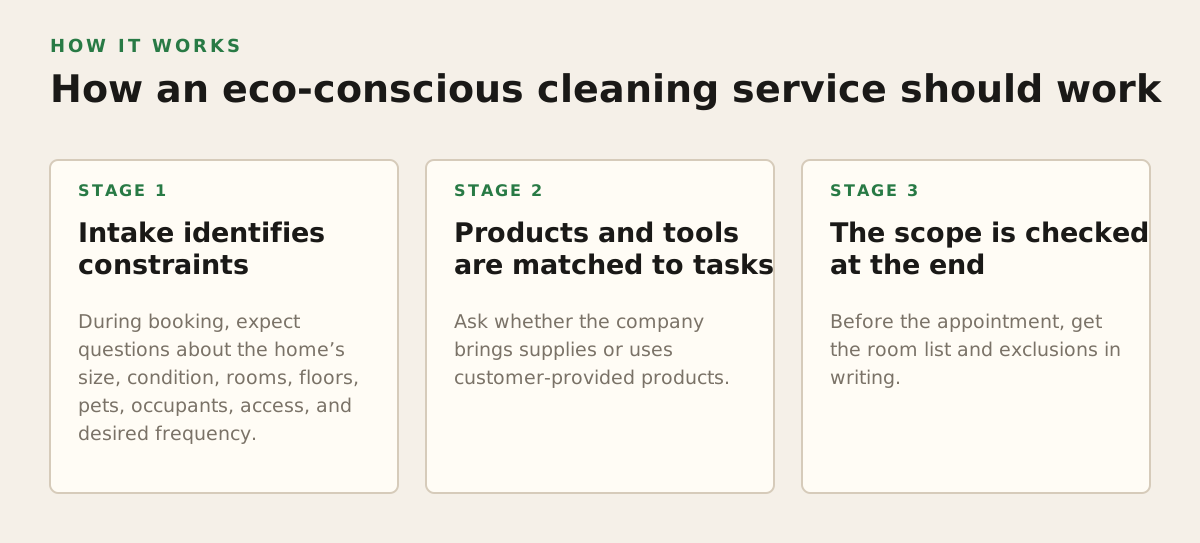
A responsible process begins before the cleaner arrives. The provider should gather enough information to match products and labor to the property rather than applying the same routine everywhere. This is especially important for older homes, stone surfaces, finished wood, septic systems, pets, asthma concerns, and move-out inspections.
1. Intake identifies constraints
During booking, expect questions about the home’s size, condition, rooms, floors, pets, occupants, access, and desired frequency. Add your own constraints: fragrance sensitivity, children crawling on floors, pets that remain in the home, preferred products, surfaces that cannot tolerate acids or abrasives, and whether you need routine cleaning or a more detailed reset.
For a property manager, the intake should also identify lockbox or access rules, inspection deadlines, appliance expectations, and whether the same checklist applies across homes. A green preference that is not written into the work order is easy to lose during handoff.
2. Products and tools are matched to tasks
Ask whether the company brings supplies or uses customer-provided products. If the provider supplies them, request product names or labels when a specific ingredient standard matters. If you provide products, confirm that the cleaner will use them and whether that changes the scope or liability for damaged surfaces.
Equipment choices can also affect waste. Reusable cloths may reduce disposable towel use, but only if they are separated, laundered, and replaced when worn. Concentrates may reduce packaging volume, but only if they are diluted correctly. Vacuum filtration may help with dust management, but the appropriate equipment depends on the flooring and the cleaner’s maintenance routine. A sustainability practice is only meaningful when its operating step is clear.
- Ask whether cloths are reusable, single-use, or mixed by task.
- Ask how used cloths are stored and laundered between homes.
- Ask whether concentrates are diluted according to the manufacturer’s instructions.
- Ask how empty containers, contaminated materials, and ordinary trash are handled.
- Ask whether the provider will ventilate spaces or leave product-specific drying instructions.
3. The scope is checked at the end
Before the appointment, get the room list and exclusions in writing. Afterward, check the high-priority areas rather than judging only by scent or shine. A useful service record can note the date, service type, requested substitutions, areas skipped because of access or safety, and any follow-up needed.
For routine customers, a recurring schedule can reduce the buildup that later requires aggressive treatment. That is one reason a modest, consistent scope may have a lower operational burden than infrequent rescue cleaning. It is not a guarantee of lower impact; frequency, home size, occupant behavior, and product choices still determine the result.
Where eco-friendly cleaning claims break down
The most common failure is a vague promise attached to an ordinary service. A company may call itself green but decline to identify products, explain training, or describe what happens when a customer requests fragrance-free work. Another failure occurs when a homeowner assumes that one preferred product can safely be used on every surface.
- Unqualified absolutes: “chemical-free,” “ toxin-free,” or “safe for everyone” claims without a defined scope or evidence.
- Certification name-dropping: a logo or certification reference with no explanation of which products, staff, locations, or procedures it covers.
- Product substitution without notice: the cleaner agrees to a low-fragrance or customer-provided product but uses a different product when arriving.
- No exception process: the provider cannot explain how it handles mineral scale, grease, mold-like staining, disinfecting requests, or delicate surfaces.
- Disposable-material ambiguity: claims about reusables without an answer about laundering, cross-home separation, or replacement.
- Pricing opacity: a low starting figure that excludes rooms, condition surcharges, supplies, travel, or requested add-ons.
Pricing deserves its own check. A flat-rate model can make the commitment easier to understand because the customer receives pricing before booking, but it does not automatically reveal the environmental practices included. An hourly model may be flexible for changing priorities, while a per-visit model may be easier to budget for recurring service. Neither is inherently greener.
Ask what changes the quote: home size, number of bathrooms, condition, frequency, pets, access, stairs, add-ons, and whether products are supplied. Do not invent a budget from generic online averages. Instead, request two comparable quotes using the same scope and ask for the price difference, if any, for fragrance-free products, customer-supplied materials, a deep clean, or a move-out checklist. Compare like-for-like scope before comparing totals.
How to evaluate a Charleston cleaning provider
Use a short interview before committing, particularly if someone in the household has asthma, fragrance sensitivity, allergies, pets, or a concern about residue. A provider does not need to answer every question with a certification to be worth considering, but it should answer clearly and avoid turning uncertainty into a marketing claim.
Vendor interview checklist
- Which products do you use for routine kitchens, bathrooms, floors, and glass?
- Can you provide product names, labels, or safety information before the first visit?
- Do you offer fragrance-free service, and does that mean no added fragrance or simply a lighter-scented product?
- Which products or tasks are excluded from the lower-impact option?
- How do you handle disinfecting requests, and do you follow the product label?
- Are cloths and mop heads reusable, and how are they laundered between homes?
- Do you bring supplies, or may I provide products that meet my household’s requirements?
- What is included in a standard, deep, recurring, or move-out visit?
- How does condition, size, access, or an added room change the quote?
- What happens if a requested product is unavailable or a surface cannot be safely cleaned?
- What can I verify after the appointment, and how are missed items handled?
A simple comparison method
Create one row for each provider and score only documented answers. Useful columns include product disclosure, fragrance policy, reusable-material process, certification scope, task exceptions, written checklist, pricing clarity, and follow-up policy. Mark unknowns as unknowns rather than awarding credit. This prevents a polished website from outranking a less flashy provider that gives more specific answers.
For recurring cleaning, request the same team or process only if the provider can actually support that expectation; do not assume continuity. For a move-out, prioritize a written room-by-room scope and inspection timing. For a deep clean, ask which neglected areas require additional labor and whether the service includes inside appliances, baseboards, blinds, or other commonly excluded tasks.
BeeLux offers house cleaning in Charleston, including one-time and recurring residential service, and deep cleaning in Charleston. The verified information available for BeeLux supports its service categories, online booking, and pricing-before-commitment model; it does not establish specific green products, certifications, fragrance-free availability, or waste practices. If those factors decide your purchase, ask BeeLux for current answers using the checklist above, then compare them with the written scope and quote.
For a straightforward Charleston cleaning need, BeeLux Cleaning is an option to evaluate for flat-rate house cleaning, deep cleaning, or move-in and move-out service. Treat its eco-friendly suitability as a question to verify—not an assumed feature—and use BeeLux Cleaning to review the available residential cleaning options.
Authored with NotFair SEO