
Blog
Deep Cleaning Maid Service in Charleston, SC: What to Expect and How to Choose One
A deep cleaning maid service is a one-time or occasional residential cleaning visit that goes beyond routine upkeep by addressing buildup, overlooked surfaces, and detail work. In Charleston, it can be the right fit before hosting guests, after a busy season, before recurring cleaning begins, or during a move. The useful question is not simply “Who cleans houses?” but what work is included, how is the scope priced, and how will completion be checked?
What a deep cleaning service actually is
Routine house cleaning is designed to maintain an already manageable home: dusting accessible surfaces, cleaning bathrooms and kitchens, vacuuming, and mopping. Deep cleaning starts with the same fundamentals but adds labor for areas that are easy to postpone, such as baseboards, doors, cabinet fronts, detailed bathroom fixtures, and accumulated kitchen residue.
The term is not a universal industry standard. One company’s “deep clean” may mean extra time in the kitchen and bathrooms; another may include interior windows, inside appliances, or reachable vents only when requested. That makes the written scope of work more valuable than the label.
Service categories and the situations they serve
- Recurring residential cleaning: Best for maintaining a home after the initial buildup is under control. It usually emphasizes repeatable tasks rather than resetting every neglected detail.
- One-time deep cleaning: Suited to homeowners or renters who want a more thorough reset without committing to a schedule.
- Move-in cleaning: Focuses on making an empty or nearly empty property ready for occupancy. Empty rooms can make floors, cabinets, closets, and fixtures easier to reach.
- Move-out cleaning: Prioritizes the condition a landlord, buyer, or next occupant will see. The lease or handover checklist should control the scope.
- Post-renovation or heavy-condition cleaning: May involve fine dust, adhesive residue, paint splatter, or construction debris. This should be confirmed specifically rather than assumed to be part of ordinary deep cleaning.
A deep clean is also not automatically a disinfecting service, carpet-cleaning service, mold-remediation service, biohazard cleanup, or exterior-pressure-washing service. Cleaning removes dirt and many germs from surfaces; disinfecting uses a product intended to kill specified germs after cleaning. The CDC explains when cleaning alone is generally appropriate in homes and when disinfection may be warranted, so a buyer should ask which process is actually being offered rather than treating the terms as interchangeable: CDC guidance on cleaning and disinfecting.
Why the distinction matters to Charleston-area buyers
Choosing the wrong category creates predictable problems. A family asking for recurring service when the home needs a first-time reset may be disappointed by the first visit. A renter ordering a general deep clean when the lease requires appliance interiors may still face a move-out dispute. A property manager sending a standard residential crew into a renovation site may receive a quote change or a refusal.
In Charleston and nearby Lowcountry communities, the practical concern is often not theoretical cleanliness; it is readiness for a specific event. A homeowner may need a kitchen and guest areas presentable before visitors. A landlord may need several vacant homes cleaned to a consistent handover standard. A busy professional may want the high-effort tasks completed once and then maintain the result with a recurring schedule. For broader recurring upkeep, compare the stated scope of house cleaning in Charleston rather than assuming a deep clean and maintenance visit are identical.
| Buyer need | Best service type | Main trade-off |
|---|---|---|
| Home has accumulated dust, grease, or bathroom buildup | One-time deep cleaning | More detail work than routine service, but not necessarily every specialty task |
| Home needs ongoing upkeep after a reset | Deep clean followed by recurring cleaning | Higher initial scope, then a regular visit and budget commitment |
| Empty property must be ready for a new occupant | Move-in cleaning | Access is easier, but inside-cabinet and appliance expectations must be stated |
| Tenant is preparing for inspection or handover | Move-out cleaning | Lease requirements may exceed a standard residential checklist |
| Multiple properties need consistent turnover | Property or multi-home cleaning plan | Requires scheduling, access coordination, and a repeatable checklist |
| Paint, drywall dust, or construction residue is present | Post-renovation cleaning if offered | May require different equipment, products, labor, or exclusions |
Success should be described in observable terms. For example, “remove visible grease from the range hood and backsplash,” “clean reachable baseboards in all included rooms,” or “vacuum and mop all accessible floors.” “Make it spotless” sounds clear but is difficult to verify and invites different interpretations.
How a professional deep clean is planned and delivered
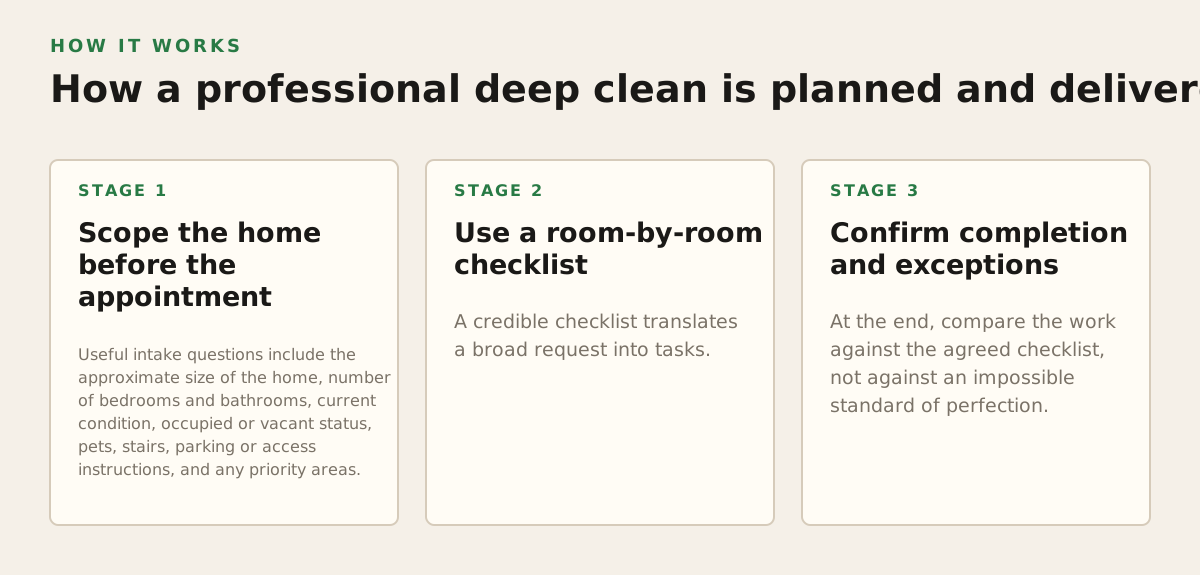
A dependable visit is a small project, not just a longer version of a routine appointment. The provider needs to understand the property, identify exclusions, estimate labor, assign the right service category, and establish what “done” means before arrival.
1. Scope the home before the appointment
Useful intake questions include the approximate size of the home, number of bedrooms and bathrooms, current condition, occupied or vacant status, pets, stairs, parking or access instructions, and any priority areas. Photos can help when the condition is difficult to describe, but they do not replace a clear written scope.
The homeowner also has implementation work. Before the crew arrives, remove fragile valuables, secure pets, clear small objects from floors and counters, and identify rooms that are excluded. If cabinets, refrigerators, ovens, or windows are required, say so in advance. Preparation affects productive cleaning time; a crew spending the first hour sorting possessions is not performing the same service as a crew arriving at clear surfaces.
- Write down the event date, such as a move-out inspection or guest arrival.
- List the three areas that matter most if the full scope cannot be completed.
- Photograph existing damage or stains that should not be attributed to cleaning.
- Confirm who provides keys, parking instructions, water, electricity, and alarm details.
- Ask whether the home must be vacant and whether someone must be present at the end.
2. Use a room-by-room checklist
A credible checklist translates a broad request into tasks. A kitchen scope might include exterior cabinet fronts, backsplash, counters, sink, faucet, appliance exteriors, floor edges, and the floor itself. If the inside of the oven, refrigerator, or cabinets is included, it should be named. Bathrooms may include shower or tub surfaces, grout attention where feasible, mirrors, fixtures, cabinet fronts, floors, and reachable baseboards.
“Reachable” and “accessible” are important constraints. Cleaning professionals should not be expected to move heavy furniture, climb unsafe surfaces, handle unknown chemicals, or remove permanently bonded residue without an agreed method. The EPA’s Safer Choice program explains how product ingredients are evaluated for safer use and environmental considerations; buyers can ask what product approach is used without assuming that every product is suitable for every surface: EPA Safer Choice information.
3. Confirm completion and exceptions
At the end, compare the work against the agreed checklist, not against an impossible standard of perfection. A practical walkthrough checks high-visibility and high-touch areas first, then notes inaccessible surfaces, permanent stains, damage, or tasks excluded from the quote.
- Kitchen: check the backsplash, range area, sink fixtures, cabinet fronts, and floor edges.
- Bathrooms: check mirrors, faucets, shower or tub surfaces, toilet exterior, and corners.
- Living areas: check dust on reachable trim, doors, furniture surfaces, and floors.
- Bedrooms: check accessible baseboards, floor edges, doors, and exposed surfaces.
- Move-related work: check inside the specifically requested cabinets, closets, and appliances.
These are concrete inspection examples, not a universal checklist. The correct list depends on the quote, property condition, and purpose of the visit.
Where deep cleaning arrangements commonly break down
Vague scope and unrealistic expectations
The most common failure is a mismatch between the buyer’s mental picture and the provider’s definition. A homeowner may expect walls washed, blinds detailed, furniture moved, and every appliance cleaned internally; the provider may have quoted accessible surface cleaning only. Solve this before booking by requesting inclusions, exclusions, add-ons, and any condition-based limitations in writing.
Stains are another source of conflict. Mineral deposits, oxidized metal, etched glass, old caulk discoloration, smoke odor, pet damage, and adhesive residue may not be removable through ordinary cleaning. A careful provider should distinguish soil that can be cleaned from damage that may remain, rather than promising a visual result no cleaning method can guarantee.
Safety, access, and product limitations
Some work is unsafe or outside residential cleaning practice: high exterior windows, active mold remediation, bodily-fluid cleanup, pest infestations, heavy lifting, and surfaces requiring restoration rather than cleaning. Chemical use also needs discipline. OSHA requires employers covered by its Hazard Communication Standard to maintain safety data sheets for hazardous chemicals in the workplace; a buyer can reasonably ask how products are labeled, stored, and used: OSHA safety data sheet guidance.
Do not combine household chemicals because a stronger result seems likely. The CDC specifically warns against mixing bleach or disinfectants with other cleaners because dangerous vapors can result: CDC cleaning and disinfection guidance. A provider should also know which surfaces cannot tolerate abrasive products, excess moisture, or acidic cleaners.
Scheduling and multi-property friction
For a single occupied home, access may be simple. For a property owner or manager, the operational burden is larger: keys, lock codes, utility status, vacancy windows, inspection deadlines, photos, and re-clean requests all need a process. A service that is adequate for one home may not be organized for several homes with different scopes.
Ask how changes are handled when a property is dirtier than described, a cleaner cannot enter, or a tenant leaves belongings behind. A defined exception process is better than a vague promise to “take care of it.” It should explain who approves extra work, how the change is documented, and whether the appointment can be rescheduled without losing the inspection window.
How to evaluate a deep cleaning provider
Pricing models and budget questions
Residential cleaning may be priced as a flat rate, an hourly service, or a customized quote. A flat rate is easier to budget when the scope and home condition are sufficiently clear. Hourly pricing can be sensible when the condition is uncertain or the buyer wants the crew to prioritize tasks until time runs out. A customized quote may be appropriate for large, vacant, multi-level, or unusually detailed properties.
Do not judge a quote by the headline number alone. Ask what labor assumption supports it, whether supplies are included, which tasks cost extra, whether the price changes with condition, and what happens if the provider cannot complete the agreed scope. A lower quote that excludes appliance interiors, baseboards, or heavy buildup may not be cheaper for the actual job.
For budgeting, use the provider’s confirmed quote rather than an internet average. If you create an internal policy for several properties, label it as a starting policy or illustrative example, not a universal benchmark. For example, a manager might require written scope confirmation before authorizing any add-on; that is a control choice, not a market standard.
Measurable success criteria
Before committing, define evidence of completion. Depending on the job, that might include a completed room checklist, photographs of vacant rooms, confirmation that specified appliance interiors were cleaned, or a documented list of inaccessible and excluded areas. For recurring service, the criterion may be consistent maintenance of agreed rooms rather than repeating every deep-clean task on every visit.
- Scope accuracy: requested rooms and named tasks are clearly included or excluded.
- Condition fit: the provider confirms whether heavy buildup, renovation residue, or specialty work is within capability.
- Access reliability: keys, codes, parking, utilities, pets, and occupancy are handled without avoidable delays.
- Result verification: there is a practical way to report a missed included task.
- Schedule fit: the service date leaves enough time before the inspection, guests, listing, or move.
Vendor interview checklist
Use these questions before booking a one-time deep clean or setting up repeat service:
- Which rooms and tasks are included in the quoted service?
- Are baseboards, doors, cabinet fronts, blinds, interior appliances, and windows included or optional?
- How do you price heavy buildup, large homes, stairs, pets, or post-renovation dust?
- What surfaces or conditions do you not handle?
- Do I need to remove clutter, move furniture, secure pets, or provide supplies?
- How are keys, alarm instructions, parking, and vacant-property access managed?
- What happens if an included task is missed or a stain cannot be removed?
- Can the same checklist be used across multiple properties?
- Is the appointment flat-rate, hourly, or subject to a condition-based revision?
- What should I expect after this visit if I want recurring cleaning?
Applying the choice to common Charleston scenarios
For a homeowner preparing for guests: choose a one-time deep clean if the home is generally functional but neglected details are visible. Prioritize the kitchen, guest bathroom, entry, floors, and rooms visitors will use. Ask whether interior windows, inside appliances, and blinds are separate tasks rather than assuming they are included.
For a renter moving out: start with the lease, move-out instructions, and any landlord checklist. Match the cleaning scope to those documents. Photograph the property after cleaning, especially appliances, floors, bathrooms, and empty cabinets. A move-out service can improve presentation, but it cannot guarantee that a landlord will waive charges for damage or repairs.
For a household seeking recurring help: use the first visit to reset neglected areas, then agree on a maintenance scope. Recurring cleaning works best when the home is reasonably accessible and the service is not repeatedly asked to perform deep-clean tasks within a maintenance budget.
For a property manager: standardize the intake form and room checklist, but allow a condition field for each property. Record vacant status, utilities, lock instructions, appliance requirements, photo needs, and deadline. This reduces rework caused by sending a generic residential scope to a home with renovation dust or abandoned belongings.
For Charleston homeowners comparing options, deep cleaning in Charleston can help clarify what a local deep-cleaning scope may look like before you request a quote. The best choice is the provider that matches the service category to the property, states limitations plainly, and gives you a verifiable scope instead of relying on the phrase “deep clean” alone.
BeeLux Cleaning offers flat-rate residential house cleaning, deep cleaning, and move-in or move-out cleaning in Charleston and surrounding Lowcountry communities, with online booking and pricing available before commitment; review BeeLux Cleaning when you are ready to compare your home’s needs with a specific service.
Authored with NotFair SEO