
Blog
Cleaning Room Checklist: A Practical Plan for Every Room
A useful cleaning room checklist separates essential tasks from occasional detail work, then assigns each task a room, priority, and frequency. Start with surfaces people touch and use, work from high to low, and finish with floors; adjust the list for your household, pets, visitors, and whether you are maintaining a home or preparing to move.
This approach helps Charleston-area homeowners and renters make a practical decision: what should be done now, what belongs on a recurring schedule, and what needs attention before a move or a deeper clean? The checklists below are starting points, not rules for every home. Skip tasks that do not apply, and add property-specific needs such as a frequently used guest room or a home office that collects dust.
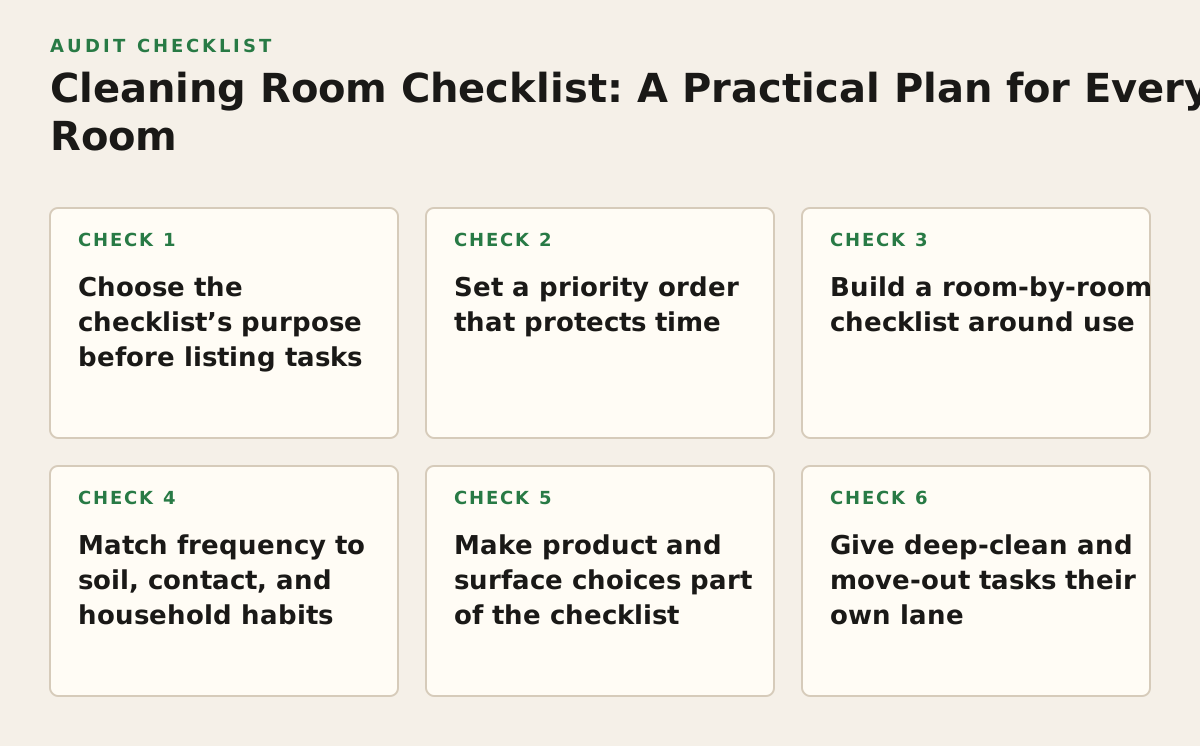
1. Choose the checklist’s purpose before listing tasks
When it applies: Start here whenever you are building a new routine, sharing chores, preparing for a move, or deciding what to ask a cleaning provider to cover. A checklist without a purpose tends to mix quick upkeep with demanding detail work, making the job seem endless.
Why it works: The same room needs different attention depending on the job. A weekly bedroom reset may focus on bedding, dust, and floors; a move-out pass also needs empty drawers, cleared shelves, and attention to areas exposed when furniture is removed. Defining the outcome lets you decide what “done” means before you begin.
Pick one outcome
- Maintenance: Keep everyday spaces usable and reduce buildup between larger cleans.
- Deep clean: Add neglected or harder-to-reach areas, such as trim, vents, and behind movable furniture where safe and practical.
- Move-related clean: Work with an empty or partly emptied room and check surfaces that belongings usually cover.
Failure mode: Calling every visit a “deep clean” can turn a short routine into a sprawling list. That makes it harder to finish the tasks that matter most. Instead, give each list a clear scope and keep extra projects separate.
Example: For a recurring living-room reset, define “done” as cleared surfaces, dusted reachable furniture, tidied cushions, and vacuumed or swept floors. Put washing curtains or cleaning behind a heavy cabinet on a separate occasional list.
2. Set a priority order that protects time
When it applies: Use a priority order when you have limited time, a busy household, or several rooms to handle. It is especially useful before guests arrive or when a move-out deadline makes it tempting to bounce between unfinished tasks.
Why it works: Cleaning becomes more efficient when you deal with visible clutter first, then clean surfaces, then floors. Dust and crumbs that fall during upper-surface work can be picked up at the end rather than tracked across a freshly cleaned floor. A consistent order also makes it easier for family members or a helper to follow the same routine.
Use a repeatable sequence
- Collect rubbish, dishes, laundry, and items that belong elsewhere.
- Clear the surfaces you need to clean; return only items with a place in the room.
- Dust high and reachable surfaces before lower ones.
- Clean task-specific surfaces, such as mirrors or kitchen counters.
- Finish with floors, moving light furniture only when it is safe to do so.
Failure mode: Cleaning around piles of belongings can leave hidden surfaces untouched and forces you to repeat work when items move. If sorting is taking too long, make a “belongs elsewhere” basket and return to it after the room is clean rather than interrupting every task.
Example: In a child’s bedroom, gather laundry and toys first, clear the desk, dust the shelf and desk, wipe the mirror if needed, and vacuum last. If the room is short on time, keep the floor route and the bed clear even if organizing a toy shelf waits.
3. Build a room-by-room checklist around use
When it applies: Use room-specific tasks when a general list misses the surfaces that matter in a particular space. This is important in homes with a busy kitchen, frequently used bathrooms, pets, or rooms with different occupants and routines.
Why it works: Rooms have different purposes, and their cleaning needs follow those purposes. A kitchen list should account for food-contact surfaces; a bathroom list should include the sink and toilet; a bedroom list should not spend its limited time on kitchen-style detailing. Keep the recurring tasks easy to scan, then put occasional work in a separate column.
| Room or area | Routine priorities | Occasional or move-related check | Practical stopping point |
|---|---|---|---|
| Kitchen | Clear dishes, wipe counters, clean the sink, sweep or vacuum the floor | Clean cabinet fronts, backsplash, and appliance exterior; check cleared drawers during a move | Food-contact work surfaces are clean, and the floor is free of loose debris |
| Bathroom | Clean sink and toilet, wipe mirror, remove visible hair and debris from floor | Address shower or tub buildup, reachable trim, and empty storage areas | Frequently used fixtures and floor are clean; supplies are put away |
| Bedroom | Make the bed, gather laundry, dust reachable surfaces, clean the floor | Check under movable furniture and wipe cleared shelves or drawers | Bed and walking paths are clear, and visible dust and floor debris are addressed |
| Living room | Return items to their places, dust tables, tidy seating, clean the floor | Clean reachable trim, lampshades according to care instructions, and areas revealed by moved furniture | Seating and main walking paths are usable without shifting piles |
These are adaptable prompts, not a promise that every finish or material can be cleaned the same way. Check manufacturer care instructions before using a new product or method on flooring, stone, wood, electronics, or upholstery.
Failure mode: A list can become a room inventory rather than a working tool. Listing every object—every shelf, frame, and handle—makes it hard to see priorities. Group comparable work, such as “dust reachable furniture,” and note only the items that need a different method or more frequent attention.
Example: If a household cooks most evenings, put counter and sink care on its kitchen routine. If a guest room is rarely used, a shorter check before visits may be more useful than treating it like the main bedroom every week.
4. Match frequency to soil, contact, and household habits
When it applies: Use this principle when deciding what belongs on a daily, weekly, or occasional list. The right interval depends on how a room is used; there is no single schedule that fits every household.
Why it works: Surfaces that see regular food preparation, splashes, or frequent hand contact can need attention sooner than a seldom-used shelf. A household with children, pets, or multiple occupants may also need more frequent pickup or floor care. Start with how quickly a surface becomes dirty, then revise the schedule if the task is consistently unnecessary or overdue.
Separate routine cleaning from disinfection
For ordinary home cleaning, CDC guidance distinguishes cleaning from disinfecting: cleaning removes dirt and impurities, while disinfecting uses a product to kill germs on a surface. CDC says cleaning alone is usually enough in most situations and describes circumstances—such as someone being sick—as reasons to consider disinfecting. Follow the product label’s directions if you disinfect, including any stated contact time. See the CDC guidance on cleaning and disinfecting at home.
In a kitchen, clean surfaces used for food preparation according to food-safety guidance. The USDA Food Safety and Inspection Service explains that cleanliness helps prevent foodborne illness and recommends washing hands, utensils, and surfaces used for food preparation. Its cleanliness guidance can help you shape a kitchen checklist; follow the instructions for the specific surface and product you use.
Failure mode: Putting “disinfect everything” on every routine list can add work without matching the household’s actual need. Keep routine cleaning distinct from any targeted disinfecting step, and do not treat a disinfectant label as interchangeable with a general surface-cleaner label.
Example: A household might put kitchen counters and the bathroom sink on a regular routine, then add a targeted disinfecting task when circumstances call for it. That schedule is an illustrative starting point, not a universal frequency; adjust it based on use and visible soil.
5. Make product and surface choices part of the checklist
When it applies: Add a product note when a room contains finishes that may be damaged by the wrong cleaner, when household members share supplies, or when you are giving instructions to someone else. A task is not complete if the method creates a new problem.
Why it works: A short, specific note can prevent a cleaner from being used on the wrong surface or mixed with another product. The U.S. Environmental Protection Agency’s Safer Choice program identifies products that meet EPA criteria for safer chemical ingredients. It can help shoppers compare options, but it does not replace surface-care instructions or the product label.
Write the method, not just the task
- Name the surface: for example, “tile counter” rather than just “counter.”
- Note any manufacturer care instruction you need to follow.
- Keep the product in its original container and use it as its label directs.
- Store cleaning products safely away from children and pets.
- Keep incompatible products separate; never improvise a mixture.
OSHA’s Hazard Communication guidance explains the role of labels and safety data sheets in communicating chemical hazards in workplaces. For household use, follow the consumer product label and any relevant surface-care guidance; workplace rules should not be treated as a substitute for either.
Failure mode: A checklist that says “spray and wipe” can encourage a person to use the wrong product or combine cleaners. Avoid shorthand where it could create confusion. If you do not know whether a product is appropriate for a surface, check the product label and the surface manufacturer’s care instructions before using it.
Example: Instead of writing “clean counters,” write “remove crumbs; use the product approved for this counter material; wipe and dry as directed.” That is more useful to a family member, a tenant, or a person helping with a move.
6. Give deep-clean and move-out tasks their own lane
When it applies: Use a separate list for tasks that do not belong in ordinary upkeep: buildup in overlooked areas, cleaning newly exposed surfaces, or getting a property ready for a handover. This is especially useful for renters and homeowners who are dividing work across rooms or people.
Why it works: Keeping occasional tasks separate makes the recurring list manageable while preserving a record of what still needs attention. A move changes the checklist because emptied cupboards and spaces behind furniture become accessible. For move-out work, check any lease, sale, or property-management instructions rather than assuming one checklist defines the required condition.
Flag tasks that need special judgment
- Mark tasks that depend on access, such as cleaning behind heavy furniture.
- Set aside stain, mold, or repair concerns instead of treating them as routine wiping tasks.
- Check whether a surface is painted, sealed, porous, or otherwise sensitive before choosing a method.
- For a move, note which rooms are empty and which still contain belongings.
For visible mold or moisture concerns, do not treat a generic checklist as a full remediation plan. The EPA’s mold cleanup guidance discusses cleanup considerations and the importance of addressing moisture. If the area or cause is uncertain, consult that guidance and consider an appropriate qualified professional rather than simply adding “scrub mold” to the list.
Failure mode: Trying to fit every deep-clean or move-out task into one visit can crowd out essential room work, while moving heavy or awkward items can create a safety risk. Mark those tasks as separate, and do not move an item unless you can do so safely.
Example: Before handing back a rental, list each room, then check the empty cupboards, drawers, and floors separately from routine tasks such as wiping counters. If an item remains in place or access is restricted, note that limitation rather than assuming the hidden area was cleaned.
7. Turn the checklist into a routine people can actually follow
When it applies: Use this step when a household shares the work, when a property has several rooms or occupants, or when you are deciding whether to keep cleaning in-house or outsource part of it.
Why it works: A checklist only helps when people know who owns each task, when to do it, and how to report a task that could not be completed. A short, repeatable list is easier to maintain than a long document that nobody updates. For multiple homes, keep a separate version for each property so that room differences do not get lost in a single generic list.
Make the checklist operational
- Use one line per task and name the room or surface.
- Assign an owner or mark the task as shared.
- Choose a frequency based on actual use, then review it after the routine has been followed.
- Add a note for access limits, delicate surfaces, or supplies that need replenishing.
- Mark “not applicable” rather than leaving an ambiguous blank.
Failure mode: A checklist that tracks completion but not exceptions can hide unfinished work. Add a small note field for “blocked,” “needs product,” or “check care instructions,” so an issue becomes a decision rather than an invisible omission.
Example: If a property manager coordinates cleaning across several homes, a shared room template can keep the structure consistent while each home’s list records its own surfaces, access instructions, and move-related requirements. Do not assume every property has identical materials or scope.
Implementation plan: build, test, and adjust your list
- Choose the job. Decide whether the checklist is for routine upkeep, a one-time deep clean, or a move.
- List the rooms and surfaces. Use the room table as a starting point; remove tasks that do not apply.
- Set a priority order. Clear clutter, work from high to low, and leave floors until last.
- Assign frequencies and owners. Base them on household use, not an assumed universal schedule.
- Add product and access notes. Include care instructions, safe-use reminders, and any task that needs separate judgment.
- Review after using it. If a task repeatedly gets skipped, clarify its owner, scope, or timing instead of adding more items.
For households that would rather outsource some recurring or one-time work, BeeLux Cleaning describes flat-rate residential house cleaning, deep cleaning, and move-in or move-out cleaning in Charleston and surrounding Lowcountry communities, with online booking and pricing shown before committing. Compare the scope you need with the details available for house cleaning in Charleston or deep cleaning in Charleston, then BeeLux Cleaning.
Authored with NotFair SEO