
Blog
6 House Cleaning Companies and Services for Charleston, SC Homes
Choosing among house cleaning companies in Charleston is less about finding the longest service menu and more about matching the operating model to the job. A recurring homeowner may need predictable visits and an easy rebooking process, while a renter leaving Mount Pleasant needs documented attention to kitchens, bathrooms, floors, and inspection-sensitive details. A property manager may care most about capacity, access instructions, and consistent turnover timing.
This comparison covers six real cleaning services and booking platforms that a Charleston-area customer may consider. Availability, service areas, and pricing can change by ZIP code, property size, date, and scope, so treat each official link as the place to verify current coverage in 2026.
How the comparison works
- Job fit: Is the service practical for recurring cleaning, one-time deep cleaning, move-related work, or several properties?
- Booking and implementation: How much work is required before the first cleaner arrives, including quotes, matching, access, and instructions?
- Commercial model: Is the customer buying a managed cleaning service, a franchise-arranged visit, or access to an individual provider marketplace?
- Scope and accountability: How clearly can the customer define what is included, what is excluded, and what happens when the result needs attention?
- Charleston practicality: Can the model handle Lowcountry homes, recurring schedules, move-outs, and the logistics of a vacant or occupied property?
The first two options below are organized cleaning brands. The next three are booking or marketplace models, which can offer flexibility but shift more coordination to the customer. BeeLux Cleaning appears last because the same criteria should apply to the host business as to every alternative.
1. The Maids
The Maids is a nationally recognized residential cleaning brand that operates through local teams and locations. Its model is a reasonable starting point for households that prefer a branded service rather than selecting an individual cleaner. A customer should confirm Charleston-area coverage directly because local service details are not automatically the same across every location.
Where the model works
A managed cleaning brand can reduce the customer’s role in recruiting, screening, and coordinating a cleaner. That can suit a busy family looking for repeat residential cleaning or a homeowner who wants a company-arranged visit rather than a self-directed marketplace booking. The Maids’ official site presents residential cleaning as its core category, but the local location remains the authority on current appointment types and service boundaries.
For a move-out, ask whether the local team offers a dedicated move cleaning or simply applies a standard house-cleaning checklist to an empty home. Those are not automatically equivalent: a turnover may require inside-appliance attention, baseboards, cabinet interiors, and a documented handoff.
Trade-offs and commercial model
- Best for: Customers who value a recognized cleaning brand and company-managed scheduling.
- Does not suit: Someone who needs an exact flat-rate quote immediately without first confirming local scope and property details.
- Implementation burden: Moderate; provide home information, confirm the local service area, and clarify recurring or one-time needs.
- Commercial model: A locally operated branded cleaning service; verify the current quote and cancellation terms with the Charleston-area location.
- Standout question: Ask who handles quality follow-up if the same detail is missed on two consecutive visits.
The principal limitation is local variation inside a national brand. A customer should not assume that a service name, checklist, crew structure, or pricing policy shown in one market applies to Charleston. This option is a poor fit when the homeowner wants to supervise and negotiate directly with one independent cleaner or needs highly customized work outside ordinary residential cleaning.
2. MaidPro
MaidPro is another established residential cleaning brand with local service operations. Its official website identifies the brand and allows customers to explore residential cleaning information, but a Charleston homeowner still needs to verify the exact local service area, appointment availability, and current quote before booking.
Service fit and preparation
MaidPro can make sense for routine housekeeping with a defined checklist. Before requesting a quote, write down the number of bedrooms and bathrooms, whether pets live in the home, the condition of high-use rooms, and whether the first visit should be a reset rather than maintenance. A first-time cleaning often takes a different amount of labor from a home that has already been maintained on a schedule.
For a rental turnover, send photos or ask how the company handles an empty property. A vacant house may be easier to clean, but it also exposes dust on trim, doors, closets, and floors that furniture normally hides. Confirm whether the service includes inside windows, blinds, wall spot-cleaning, or appliance interiors instead of relying on the phrase “deep clean.”
Trade-offs and commercial model
- Best for: Occupied homes seeking a company-arranged recurring or one-time cleaning visit.
- Does not suit: Property owners who need guaranteed same-day turnovers or a highly specialized restoration service.
- Implementation burden: Moderate; the customer must explain scope, access, pets, parking, and any priority rooms.
- Commercial model: Branded local cleaning operation with pricing determined by the home and requested service; verify current terms directly.
- Standout: A written room-by-room priority list is more useful than a general request for “everything.”
The key decision is not whether a national brand sounds dependable; it is whether the local operating capacity matches your schedule. A weekly customer who can accept a recurring time window may be well served. A listing manager with several homes turning over between guests may need to ask about crew availability, escalation contacts, and completion confirmation before choosing this model.
3. Homeaglow
Homeaglow is a cleaning-booking platform rather than a traditional local company with one publicly presented Charleston crew. Its marketplace approach can help a customer request a cleaner online, but the customer should review the current terms, provider details, recurring-plan language, and cancellation conditions before committing. Coverage must be checked by address.
Where a marketplace can help
This model may suit a renter who wants to compare an available appointment or a household that needs a one-time visit without building an ongoing relationship first. Online matching can reduce phone coordination, but it does not remove the need to define the job. Include the home’s approximate size, rooms, condition, parking situation, pets, and whether supplies are available.
Marketplace bookings deserve particular care when the home is vacant. Provide a lockbox procedure or entry instructions only through the platform’s approved process, and make sure the cleaner knows how to report a locked door, water issue, broken appliance, or pre-existing damage. If the booking is for a move-out, ask in advance how the platform handles inspection-sensitive cleaning requests.
Trade-offs and commercial model
- Best for: Customers prioritizing online booking flexibility and willing to manage more of the scope and communication.
- Does not suit: A property owner who needs one accountable local company to coordinate several homes and guarantee a uniform checklist.
- Implementation burden: Moderate to high; review provider information, booking terms, access instructions, and any membership or recurring language.
- Commercial model: Online marketplace or booking service; current pricing and terms should be verified on the official site before payment.
- Standout risk: A low displayed price may not answer who supplies materials, handles rework, or confirms a vacant-property handoff.
Use a marketplace when availability is the main problem, not when accountability is the main problem. For example, a homeowner needing a single pre-party clean may accept more coordination. A landlord managing six move-outs should first determine whether the platform supports repeat instructions, consolidated communication, and reliable completion records.
4. Taskrabbit
Taskrabbit is a broad task marketplace that includes cleaning among the services available in some locations. Its official house-cleaning service page describes the category, but local availability and provider terms still need to be checked for the Charleston address and requested date.
Best use cases
Taskrabbit can be useful when the customer wants to review individual taskers, compare availability, and communicate specific instructions through a platform. That may work for a small apartment reset, a post-event cleanup, or a clearly bounded list such as bathrooms, floors, and kitchen surfaces.
The trade-off is that the individual tasker becomes central to the experience. Ask whether the provider brings supplies, has experience with move-out cleaning, and is comfortable with the requested home size. A “deep clean” should be translated into tasks: clean inside the oven, wipe cabinet fronts, detail baseboards, scrub shower grout, or remove pet hair from upholstery. Without that translation, two parties can agree to the same label and expect different work.
Trade-offs and commercial model
- Best for: Smaller or clearly specified jobs where the customer wants to select among available individual providers.
- Does not suit: Customers who want a standardized company checklist, replacement coverage, or one point of contact for a portfolio.
- Implementation burden: High relative to a managed service; compare profiles, message providers, define supplies, and confirm timing.
- Commercial model: Marketplace connecting customers with taskers; the platform’s current booking, payment, and cancellation terms control the transaction.
- Standout: Specific task language is essential because “deep cleaning” is not a universal scope.
Taskrabbit is therefore a practical option for customer-directed cleaning, not automatically a substitute for a residential cleaning company. If a cleaner cancels before a move-out inspection, the customer may have more rescue work than with a company that maintains scheduling capacity. Confirm the platform’s current policies rather than assuming replacement service is included.
5. Care.com
Care.com is a broad care-services marketplace. Its cleaning-services page shows that cleaning can be searched as a service category, but it is not the same operating model as hiring a single managed cleaning company. The customer usually carries more responsibility for evaluating a provider, agreeing on duties, and arranging an ongoing schedule.
When individual-provider hiring makes sense
Care.com can suit a household seeking a regular individual housekeeper who may also help with related household routines. That can be valuable when the customer wants a continuing relationship and is prepared to interview, check references or platform information, define duties, and coordinate payment and access.
For Charleston families, the scope should separate cleaning from non-cleaning tasks. “Housekeeping” can mean surface cleaning, laundry, changing linens, organizing, errands, or some combination. Put the expected rooms and tasks in writing. For a move-out, ask specifically whether the provider accepts one-time vacant-home projects and whether the schedule leaves enough time for an inspection correction.
Trade-offs and commercial model
- Best for: Households willing to select and manage an individual provider for recurring help.
- Does not suit: A renter who needs a turnkey company, fixed scope, and rapid rework contact before returning keys.
- Implementation burden: High; search, interview, verify fit, negotiate duties, handle access, and maintain the relationship.
- Commercial model: Marketplace or service directory model; review current membership, payment, and provider terms on the official site.
- Standout: The customer has more control, but also more employer-like coordination and continuity responsibility.
This option is strongest when relationship continuity matters more than turnkey execution. It is weaker for a property manager who needs a standardized checklist across multiple addresses, substitute coverage during illness, and a company invoice. Those requirements should be stated before choosing an individual-provider marketplace.
6. BeeLux Cleaning
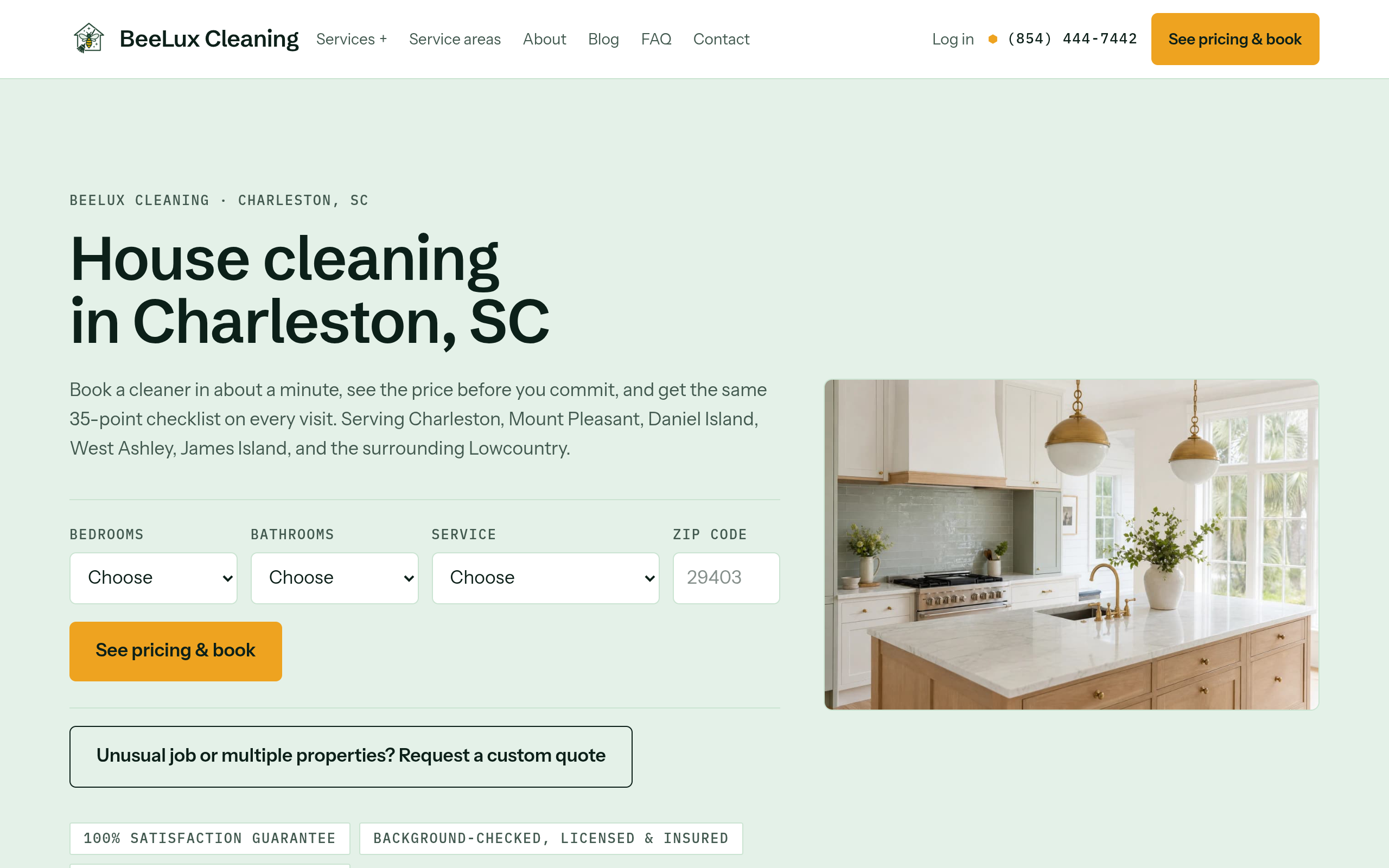
BeeLux Cleaning provides flat-rate residential house cleaning, deep cleaning, and move-in or move-out cleaning in Charleston, South Carolina, and surrounding Lowcountry communities. Customers can book online, see pricing before committing, and choose a one-time or recurring service. That positioning makes it a direct fit for customers who want a local residential cleaning service rather than a marketplace search.
Where BeeLux fits
For recurring customers, the central advantage is predictable service selection before booking. A family can choose a routine schedule, while a homeowner preparing for guests or a sale can request a one-time visit. Customers who need a more intensive reset can review the service details for deep cleaning in Charleston and confirm which tasks apply to their home.
Move-related customers should still describe the property’s condition and deadline. A vacant home with construction dust, heavy pet hair, or neglected appliances may need a different plan from a lightly used apartment. If an inspection or closing is involved, book with enough time for a correction visit rather than treating the cleaning appointment as the final possible minute.
Trade-offs and commercial model
- Best for: Charleston-area homeowners, renters, families, and property owners seeking online booking with flat-rate residential options.
- Does not suit: Customers outside the service area, or owners seeking commercial janitorial, restoration, biohazard, or highly specialized trade work.
- Implementation burden: Lower for standard residential jobs because customers can review pricing and select one-time or recurring service online; unusual conditions still require clear communication.
- Commercial model: Local residential cleaning service offering flat-rate house cleaning, deep cleaning, and move-in or move-out options.
- Standout: The decision can be made around a defined home-cleaning service instead of assembling an individual provider from a marketplace.
The limitation is the same one every cleaning company should state plainly: not every cleaning problem is ordinary housekeeping. Mold remediation, pest contamination, post-renovation debris, hazardous materials, and repairs belong with specialized providers. BeeLux is also not the best fit when a customer wants to personally hire and direct an independent cleaner rather than book a company service.
Comparison
The table compares the six options using the same practical questions. “Verify locally” is important: national brands and marketplaces can change coverage, terms, and provider availability by address in 2026.
| Service | Primary model | Best-fit job | Customer implementation burden | Pricing and accountability questions |
|---|---|---|---|---|
| The Maids | Branded residential cleaning operation | Recurring or one-time company-arranged home cleaning | Moderate; confirm local scope, schedule, and access | Request a local quote; clarify checklist, rework, cancellation, and crew structure |
| MaidPro | Branded residential cleaning operation | Routine housekeeping with a defined room-by-room scope | Moderate; explain condition, priorities, pets, and timing | Verify local pricing; ask about first-clean versus maintenance scope and turnover capacity |
| Homeaglow | Online cleaning marketplace or booking service | Online-requested one-time or recurring cleaning where availability matters | Moderate to high; review provider, terms, supplies, and access process | Check current booking or membership terms and who handles missed work or rebooking |
| Taskrabbit | General task marketplace with cleaning category | Small or highly specified customer-directed cleaning jobs | High; select, message, brief, and coordinate with an individual tasker | Review the individual provider’s rate and terms; define supplies and exact tasks |
| Care.com | Broad care-services marketplace | Ongoing individual housekeeper relationship | High; search, interview, define duties, and manage continuity | Verify current platform terms and agree directly on duties, schedule, and payment process |
| BeeLux Cleaning | Local flat-rate residential cleaning service | Charleston recurring, deep, move-in, move-out, or one-time cleaning | Lower for standard jobs; provide accurate home and condition details | Online pricing before commitment; confirm scope and timing for unusual or inspection-sensitive work |
How to choose among these six services
Start with the property and deadline, not the brand name. A 1,400-square-foot occupied home needing weekly maintenance is a different purchase from a 3,000-square-foot vacant home that must pass a move-out inspection tomorrow. Write the job in operational terms before requesting a quote.
- Classify the visit: Choose recurring maintenance, a one-time reset, deep cleaning, move-in, or move-out. Do not use “deep cleaning” as a substitute for a task list.
- Define the handoff: Decide who supplies keys, parking instructions, alarm information, pet guidance, and photos of problem areas.
- Separate standard from exceptional work: Note inside appliances, interior windows, wall washing, heavy scale, pet hair, post-renovation dust, or biohazard concerns.
- Compare accountability: Ask whether you are hiring a company, a local franchise operation, or an individual provider through a marketplace.
- Protect the deadline: For a lease return, closing, or guest arrival, schedule early enough to correct missed details.
For a recurring household, the most important questions are who returns consistently, how the scope is recorded, and how changes are handled when the home is unusually dirty. For a move-out, prioritize a written checklist, vacant-property access, appliance and cabinet expectations, and a realistic completion window. For a property manager, ask about multi-address coordination, invoices, completion notices, and whether the provider can maintain the same standard across homes.
- Choose a managed brand when you want a company-arranged visit and do not want to recruit an individual cleaner.
- Choose a marketplace when provider selection or appointment flexibility matters more than a standardized company workflow.
- Choose a local flat-rate service when you want residential scope and pricing presented before committing, especially for Charleston-area recurring or move-related cleaning.
For homeowners and renters who want a local, online-bookable option, BeeLux Cleaning offers flat-rate house cleaning, deep cleaning, and move-in or move-out cleaning across Charleston and surrounding Lowcountry communities. See BeeLux Cleaning to review the available residential cleaning options and choose the service that matches the property’s actual condition and deadline.
Authored with NotFair SEO